
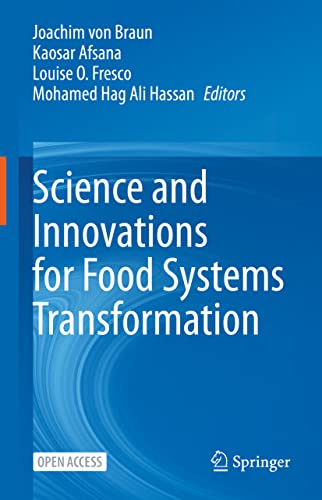
Science and innovations for food systems transformation / edited by Joachim von Braun, Kaosar Afsana, Louise O. Fresco, Mohamed Hag Ali Hassan.
Material type: TextPublication details: Cham : Springer International Publishing : c2023.Description: xxii, 948 pages : illustrations ; 24 cmISBN:
 - 9783031157028
- 9783031157035 (ebook)
- 23 630
| Item type | Current library | Home library | Call number | Copy number | Status | Date due | Barcode | Item holds |
|---|---|---|---|---|---|---|---|---|
 Book
Book
|
Ayesha Abed Library General Stacks | Ayesha Abed Library General Stacks | 630 SCI (Browse shelf(Opens below)) | 1 | Available | 3010044646 |
Includes bibliographical references
Part I : FOOD SYSTEM CONCEPT AND SUMMARIZED RECOMMENDATIONS
Chapter 1: Food systems: seven priorities to end hunger and protect the planet
Chapter 2: Food system concepts and definitions for science and political action
Part II: ACTIONS ON HUNGER AND HEALTHY DIETS
Chapter 3: Healthy diet
A Definition for the United Nations Food Systems Summit 2021
Chapter 4: Ensuring Access to Safe and Nutritious Food for All Through Transformation of Food Systems
Chapter 5: Shift to Healthy and Sustainable Consumption Patterns
Chapter 6: Fruits and Vegetables for Healthy Diets: Priorities for Food System Research and Action
Chapter 7: Modelling Actions for Transforming Agrifood Systems
Part IV: ACTIONS FOR EQUITY AND RESILIENCE IN FOOD SYSTEMS
Chapter 8: Advance Equitable Livelihoods
Chapter 9: A Review of Evidence on Gender Equality, Women's Empowerment and Food Systems
Chapter 10: The Future of Small Farms: Innovations for Inclusive Transformation
Chapter 11: Diversification for enhanced food systems resilience
Chapter 12: Addressing Food Crises in Violent Conflicts
Chapter 13: In brief: The White/Wiphala Paper on Indigenous Peoples' food systems
Chapter 14: Marginal areas and Indigenous people
Priorities for research and action
Chapter 15: Priorities for inclusive urban food system transformations in the Global South
Chapter 16: Secondary Cities as Catalysts for Nutritious Diets in Low- And Middle-Income Countries
Part V: ACTIONS FOR SUSTAINABLE FOOD PRODUCTION AND RESOURCE MANAGEMENT
Chapter 17: Boost Nature Positive Production. Chapter 18: Pathways to Advance Agroecology for a Successful Transformation to Sustainable Food Systems
Chapter 19: A New Paradigm for Plant Nutrition
Chapter 20: Livestock and sustainable food systems: status, trends, and priority actions
Chapter 21: The Vital Roles of Blue Foods in the Global Food System
Chapter 22: Food System Innovations and Digital Technologies to Foster Productivity Growth and Rural Transformation
Chapter 23: Leveraging data, models & farming innovation to prevent, prepare for & manage pest incursions: Delivering a pest risk service for low-income countries
Chapter 24: Food Systems Innovation Hubs in Low-and-Middle-Income Countries
Chapter 25: A Whole Earth Approach to Nature Positive Food: Biodiversity and Agriculture
Chapter 26: Water for Food Systems and Nutrition
Chapter 27: Climate Change and Food Systems
Chapter 28: Delivering climate change outcomes with agroecology in low- and middle-income countries: evidence and actions needed
Chapter 29: Crop Diversity, its Conservation and Use for Better Food Systems
Chapter 30: Safeguarding and using Fruit and Vegetable Biodiversity
Chapter 31: Reduction of Food Loss and Waste
The Challenges and Conclusions for Actions
Part V: COSTS, INVESTMENT, FINANCE, AND TRADE ACTIONS
Chapter 32: The True Cost of Food
a preliminary assessment
Chapter 33: Cost and Affordability of Preparing a Basic Meal around the World
Chapter 34: The global cost of reaching a world without hunger: Investment costs and policy action opportunities
Chapter 35: Financing SGD2 and Ending Hunger
Chapter 36: Trade and Sustainable Food Systems
Part VI: Regional Perspectives
Chapter 37: Policy Options for food system transformation in Africa and the role of science, technology and innovation
Chapter 38: The Role of Science, Technology and Innovation for Transforming Food Systems in Latin America and the Caribbean
Chapter 39: The Role of Science, Technology, and Innovation for Transforming Food Systems in Asia
Chapter 40: The Role of Science, Technology, and Innovation for Transforming Food Systems in Europe
Chapter 41: Transforming Chinese Food Systems for both Human and Planetary Health
Chapter 42: Key Areas of the Agricultural Science Development in Russia in the Context of Global Trends and Challenges
Chapter 43: Food System in India. Challenges, Performance and Promise
Part VII: STRATEGIC PERSPECTIVES AND GOVERNANCE
Chapter 44: The Role of Science, Technology and Innovation for Transforming Food Systems Globally
Chapter 45: The Bioeconomy and Food Systems Transformation
Chapter 46: In the Age of Pandemics, connecting Food Systems and Health: a Global One Health Approach
Chapter 47: How could science-policy interfaces boost food system transformation?
Chapter 48: The Transition Steps Needed to Transform Our Food Systems
Chapter 49: Engaging Science in Food Systems Transformation: Toward Implementation of the Action Agenda of the United Nations Food Systems Summit
Chapter 50: Science for Transformation of Food Systems: Opportunities for the UN Food Systems Summit
This Open Access book compiles the findings of the Scientific Group of the United Nations Food Systems Summit 2021 and its research partners. The Scientific Group was an independent group of 28 food systems scientists from all over the world with a mandate from the Deputy Secretary-General of the United Nations. The chapters provide science- and research-based, state-of-the-art, solution-oriented knowledge and evidence to inform the transformation of contemporary food systems in order to achieve more sustainable, equitable and resilient systems
There are no comments on this title.