
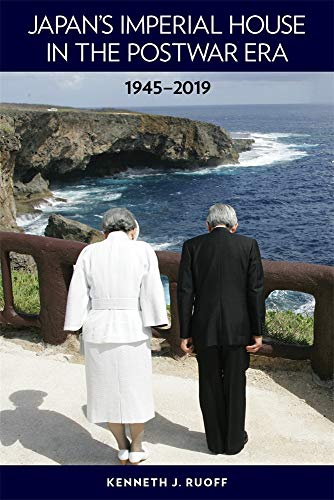
Japan's imperial house in the postwar era, 1945-2019 / Kenneth J. Ruoff.
Material type: TextSeries: Harvard East Asian monographs ; 432.Publication details: Cambridge, Massachusetts : Harvard University Asia Center, 2020.Description: xviii, 419 pages : illustrations (some color) ; 23 cmISBN:
 - 0674244478
- 9780674244474
- 0674244486
- 9780674244481
- People's emperor
- Hirohito, Emperor of Japan, 1901-1989
- Akihito, Emperor Emeritus of Japan, 1933-
- Since 1900
- Monarchy -- Japan -- History -- 20th century
- Democracy -- Japan -- History -- 20th century
- Constitutional history -- Japan
- Royal houses -- Japan -- History -- 20th century
- Histoire constitutionnelle -- Japon
- Maisons royales -- Japon -- Histoire -- 20e siècle
- Constitutional history
- Democracy
- Kings and rulers
- Monarchy
- Politics and government
- Royal houses
- Monarchie
- Monarchy -- Japan -- History -- 20th century
- Democracy -- Japan -- History -- 20th century
- Constitutional history -- Japan
- Royal houses -- Japan -- History -- 20th century
- Japan -- Politics and government -- 1945-
- Japan -- Kings and rulers
- Japon -- Politique et gouvernement -- 1945-
- Japan
- Japan
- Japan -- Politics and government -- 1945-
- Japan -- Kings and rulers
- 320.45209045 23
- JQ1640 .R86 2020
| Item type | Current library | Home library | Call number | Copy number | Status | Date due | Barcode | Item holds |
|---|---|---|---|---|---|---|---|---|
 Book
Book
|
Ayesha Abed Library | Ayesha Abed Library | 320.45209045 ROU (Browse shelf(Opens below)) | 1 | Available | 3010045877 |
Revision of The people's emperor : democracy and the Japanese monarchy, 1945-1995.
Includes bibliographical references (pages 389-403) and index.
1 The Monarchy, "660 BCE"-1945 p. 20 -- The Making of the Modern Monarchy p. 22 -- The Monarchy after World War I p. 33 -- The Emperor System and the Fifteen-Year War, 1931-45 p. 37 -- 2 The Constitutional Symbolic Monarchy p. 47 -- The Symbolic Monarchy as Japanese Tradition p. 49 -- Interpreting the Emperor's New Role p. 57 -- The Imperial Decoration System p. 72 -- Contesting the Symbolic Monarchy p. 74 -- Official Legitimization p. 83 -- The "Constitutional Symbolic Monarchy Under Popular Sovereignty" p. 91 -- 3 Ministerial Briefings and Emperor Hirohito in Politics p. 94 -- Briefings Under the New Constitution and the Occupation, 1947-52 p. 99 -- The Post-Occupation Period p. 114 -- 4 Imperial War Responsibility and Apologies p. 135 -- Emperor Hirohito's New Clothes p. 136 -- Emperor Hirohito and General Charles de Gaulle: Referents for Sanitized Memories of the War in Japan and France p. 145 -- The Right's Endorsement of the Symbolic Monarchy p. 148 -- Imperial Apologies and the Constitution p. 153 -- 5 Nationalistic Movements to Restore Cultural Symbols of the Monarchy p. 169 -- The Foundation Day Re-establishment Movement p. 171 -- The Movement to Perpetuate the Reign-Name System p. 195 -- 2019 Adendum p. 214 -- 6 The "Monarchy of the Masses" p. 216 -- Hirohito, Emperor of the People? p. 218 -- The Emergence of Crown Prince Akihito p. 226 -- An Imperial "Love Match" p. 235 -- Backlash against the Monarchy of the Masses p. 254 -- The Warm, Fuzzy Heisei Monarchy p. 261 -- 7 From the Heisei Era to the Reiwa Era p. 272 -- The Heisei Agenda p. 283 -- Mixed Messages and Absences p. 308 -- The Reiwa Era p. 317 -- 8 The Abdication of Emperor Akihito and the Fragility of the Imperial Line p. 327 -- The Abdication in Historical Context p. 329 -- The Fragility of the Imperial Line p. 339.
With the ascension of a new emperor and the dawn of the Reiwa Era, Kenneth J. Ruoff has expanded upon and updated The People's Emperor, his study of the monarchy's role as a political, societal, and cultural institution in contemporary Japan. Many Japanese continue to define the nation's identity through the imperial house, making it a window into Japan's postwar history. Ruoff begins by examining the reform of the monarchy during the U.S. occupation and then turns to its evolution since the Japanese regained the power to shape it. To understand the monarchy's function in contemporary Japan, the author analyzes issues such as the role of individual emperors in shaping the institution, the intersection of the monarchy with politics, the emperor's and the nation's responsibility for the war, nationalistic movements in support of the monarchy, and the remaking of the once-sacrosanct throne into a "people's imperial house" embedded in the postwar culture of democracy. Finally, Ruoff examines recent developments, including the abdication of Emperor Akihito and the heir crisis, which have brought to the forefront the fragility of the imperial line under the current legal system, leading to calls for reform. -- Publisher.
AAL
There are no comments on this title.